

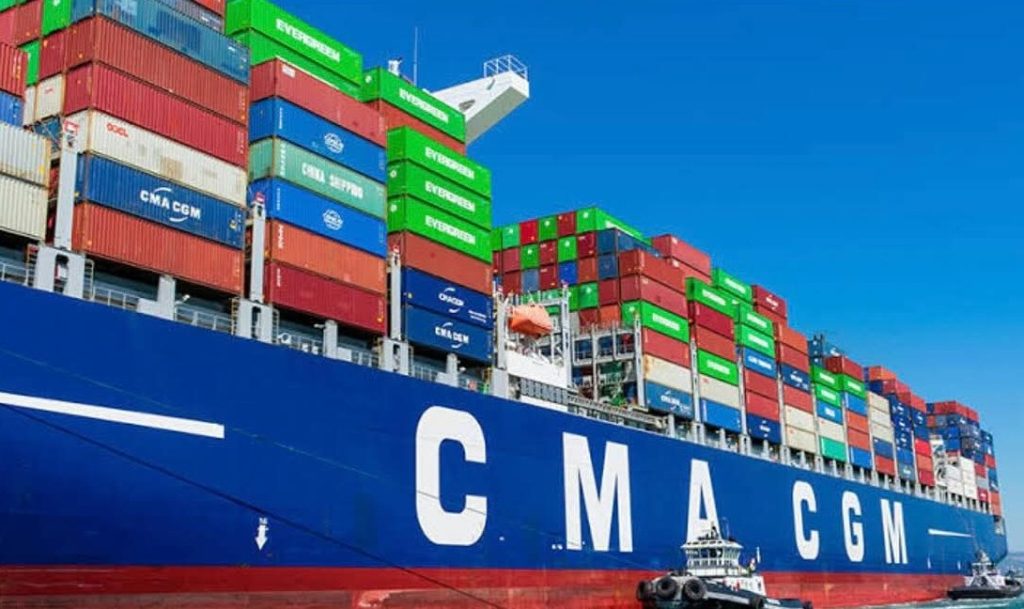
French shipping giant CMA CGM has announced a new Peak Season Surcharge (PSS) on cargo bound for Nigeria and other West African ports, a move that could see importers paying up to ₦1 million in additional charges.
In an official statement, the company said that beginning September 15, 2025, importers will pay an extra $500 per 20-foot container for both dry and reefer cargo originating from North East Asia, South East Asia, China, Hong Kong, and Macau SAR, with the surcharge applied “until further notice.”
CMA CGM offered little justification beyond citing its “continued effort to provide our customers with reliable and efficient services.”
Ad space
According to the United Nations Conference on Trade and Development (UNCTAD), surcharges are typically temporary measures introduced by shipping lines to address specific challenges at destinations and are meant to be removed once conditions normalise.
The $500 per TEU surcharge comes on top of existing costs in the freight invoice, which include the freight rate, the Bunker Adjustment Factor (BAF) for fuel price fluctuations, and the Currency Adjustment Factor (CAF) to account for exchange rate volatility.
Nigerian importers also shoulder additional expenses such as port handling charges, storage costs, customs fees, and war risk premiums—the latter of which the government has been pushing to eliminate. Documentation fees, including Bill of Lading and terminal handling charges, also apply.
The Nigeria Shippers Council (NSC) has vowed to take up the matter with CMA CGM for possible resolution.
“There are two ways to address this surcharge issue. Either for them to finally drop the surcharge, looking at some economic indices and parameters, or we ask for a reduction,” said Celestine Akujobi, Director of Consumer Affairs at the NSC.
He, however, acknowledged that surcharges are “something that is practical in the industry,” noting that the $500 fee may have been triggered by rising cargo volumes. “It happens when the volume increases and there is no capacity, in terms of no vessel capacity, or even no container capacity, on certain trade routes,” he added.
This is not the first time CMA CGM has imposed surcharges on imports to West Africa. In February 2020, it introduced a $1,500 PSS on cargo from the United States, alongside a General Rate Restoration (GRR) of $500 per 20-foot container and $1,000 per 40-foot container of dry, reefer, OOG, and break-bulk cargo from Asia, including China, South Korea, and Taiwan. That surcharge was later dropped after the NSC escalated the issue through the Union of African Shippers Councils and the Global Shippers Forum.
Meanwhile, clearing agents say the timing of the new surcharge is particularly difficult, as importers already face multiple costs and policy uncertainties.
“Because of one policy somersault after another, and increment of charges, some couldn’t cope at all,” said Sulaiman Ayokunle, a clearing agent and spokesperson for the president of the Association of Nigeria Licensed Customs Agents (ANLCA).
He cautioned that CMA CGM risks losing business to competitors: “If anybody is taking advantage of high demand, they should remember they have more competitors that are springing up.”
Nigeria, lacking a national carrier, depends heavily on foreign shipping giants like Maersk, MSC, and Hapag-Lloyd, whose investments in automated services are making them increasingly attractive to importers seeking better value.




Comments