

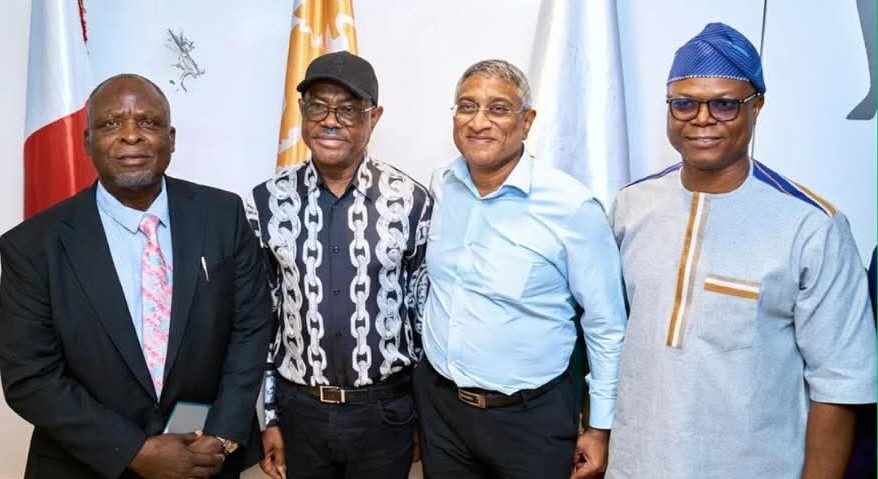
Following recurring concerns around stormwater control and access reliability in the Central Business District (CBD) during heavy rains and peak traffic periods, the Minister of the Federal Capital Territory Administration, Nyesom Wike, has inspected ongoing public infrastructure works along the World Trade Centre (WTC) Abuja corridor and the Metro Rail axis.
The upgrade works, being handled by Julius BergerNigeria Plc through the Federal Capital Development Authority, aimed at strengthening stormwater management, improving circulation, and reducing disruptions around one of the CBD’s busiest commercial corridors.
FCT officials said that although drainage and access improvements are rarely given publicity, their impact in dense business districts is significant, as poor drainage and deteriorating road conditions often translate into traffic congestion, as well as delayed arrivals, visitor bottlenecks, and delivery disruptions, all of which impose hidden operating costs on businesses over time.
Ad space
The minister also visited WTC Abuja, a mixed-use development comprising a 22-storey Grade A commercial office tower offering over 33,000 square metres of lettable space, alongside a 24-storey residential tower with 120 apartments.
During the visit, Wike acknowledged that the WTC Abuja complex has added considerable value to the capital city’s skyline and commercial profile. He was received by Chief Operating Officer, Churchgate Group, Jerome Das, who expressed appreciation to the FCT Administration for prioritising infrastructure upgrades within the CBD.
General Manager, Churchgate Group, Mr Ibukun Adeogun, explained that the mixed-use development is designed to serve corporate, diplomatic, financial and professional service organisations, as well as residents seeking high-quality CBD living. Amenities within the complex include a clubhouse, gymnasium, swimming pool, and squash and tennis courts.
Adeogun noted that the ongoing public works complement the operating environment around the World Trade Centre Abuja by improving surrounding access and overall district functionality. According to him, available office space offers flexibility, ranging from shell and core to Category A and turnkey delivery, with units from 100 square metres to 1,500 square metres, supported by fit-out assistance or full fit-out solutions.
He added that ministerial site inspections signal a broader focus on enabling infrastructure, the practical fundamentals that determine whether a central business district functions predictably for institutions operating under strict internal standards.
“This is particularly relevant for corporates, embassies and financial institutions, where duty-of-care expectations and business continuity planning place a premium on predictable movement for staff and visitors,” he said. “A location can be architecturally impressive yet underperform operationally if approach routes and stormwater resilience are weak.”
According to him, the inspection underscores Abuja’s investment readiness and a renewed emphasis on infrastructure that ensures the CBD functions reliably for organisations requiring stability.
For the World Trade Centre Abuja, Adeogun argued, improved public realm performance strengthens the experience around a destination already designed for high-compliance and operationally focused occupier.
Comments